Rubio Meeting Highlights Kazakhstan’s Growing U.S. Agenda

U.S. Secretary of State Marco Rubio’s April 15 meeting with senior Kazakh officials in Washington gave fresh visibility to a relationship that both sides increasingly frame in economic as well as diplomatic terms. At a time when Washington is trying to give its Central Asia policy more practical shape, Kazakhstan is a key U.S. partner in the region.
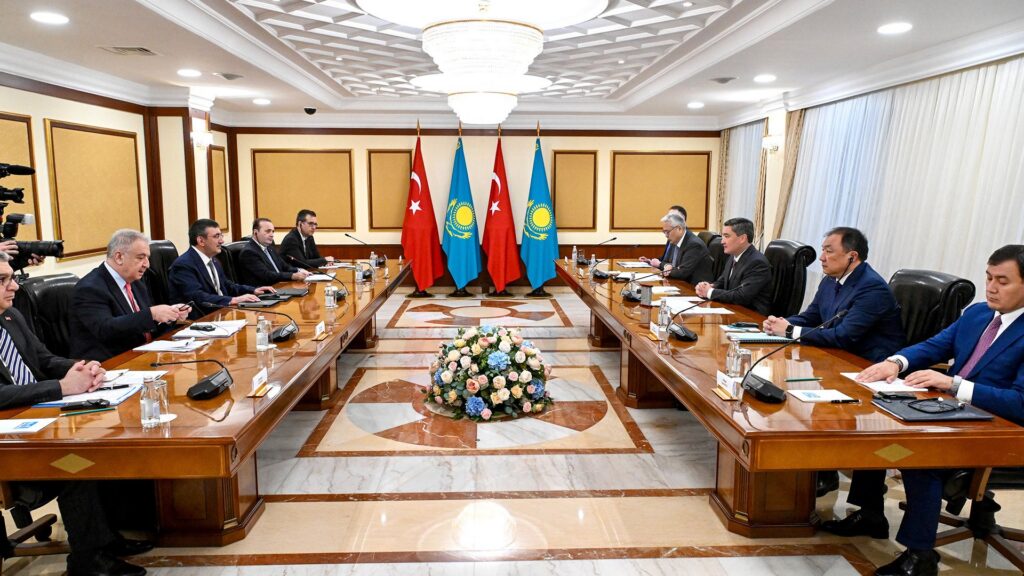
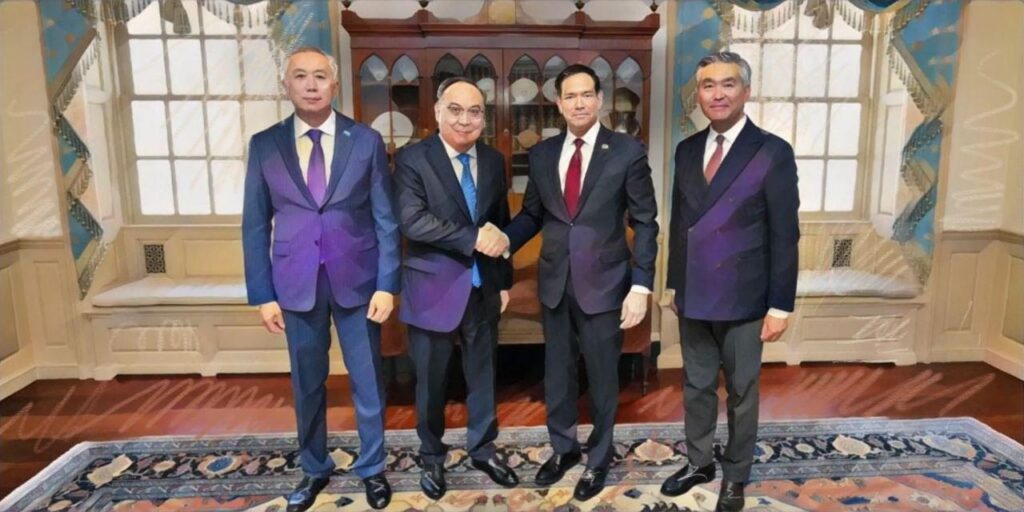
Rubio met President Tokayev’s Special Representative for Negotiations with the United States, Erzhan Kazykhan, and Deputy Prime Minister and Minister of National Economy, Serik Zhumangarin. The talks covered ways to expand economic ties between the United States and Kazakhstan, as well as Kazakhstan’s role in peacemaking and regional initiatives. Rubio also welcomed Kazakhstan’s participation in the C5+1 platform and reaffirmed U.S. support for the country’s “sovereignty, independence, and territorial integrity.”
In a post on X, Rubio said the talks focused on strengthening commercial ties and advancing regional cooperation. That language put trade, investment, and regional economic coordination at the center of the meeting.
Launched in 2015, the C5+1 began as a diplomatic framework linking the United States and the five Central Asian states. It later broadened into a more structured platform, with working groups on trade, energy, and the environment, and with growing emphasis on logistics, diversification, supply chains, and investment. The rise of the B5+1 reinforced that shift by giving business a more formal place in the relationship. By late 2025, the format placed more emphasis on deliverables, including infrastructure, funding mechanisms, and cooperation on mineral processing and research.
That shift has also been visible in Kazakhstan’s own dealings with Washington. During President Kassym-Jomart Tokayev’s visit to the United States in November 2025, the Kazakh delegation signed 29 bilateral agreements worth about $17 billion, including a memorandum on critical minerals cooperation and major commercial deals in aviation, agriculture, and mining. The same visit underlined how closely economic diplomacy and strategic supply concerns are now tied together. Kazakhstan has attracted roughly $100 billion in cumulative U.S. investment since independence, and critical minerals have moved closer to the center of the relationship as Washington looks for secure supply chains beyond China and Russia.
Kazakhstan has attracted over $151 billion in net foreign direct investment since independence.
Rubio’s talks with Zhumangarin and Kazykhan came after months of stronger U.S.-Kazakhstan economic contact. Kazakhstan has a larger economic profile than any other Central Asian state, and its role in energy, critical minerals, investment, and transit gives it a prominent place in Washington’s regional thinking. That makes Astana a natural focus for any U.S. push to deepen commercial ties in Central Asia.
The sovereignty language in the U.S. readout was also not incidental. For Kazakhstan, public backing from Washington on sovereignty, independence, and territorial integrity carries political weight in a region where questions of borders, pressure, and strategic dependence remain sensitive. Astana’s multi-vector foreign policy is built on preserving room for maneuver among larger powers. High-level engagement in Washington supports that strategy and signals that closer U.S. ties can sit alongside Kazakhstan’s broader balancing act.
The Washington visit also included a gesture toward one of Kazakhstan’s strongest supporters in Congress. During a ceremony at the Kazakh Embassy, Senator Steve Daines received the Order of Dostyk, First Class, on behalf of President Tokayev. The award recognized his “significant contribution to strengthening friendship and advancing cooperation between the two countries.”
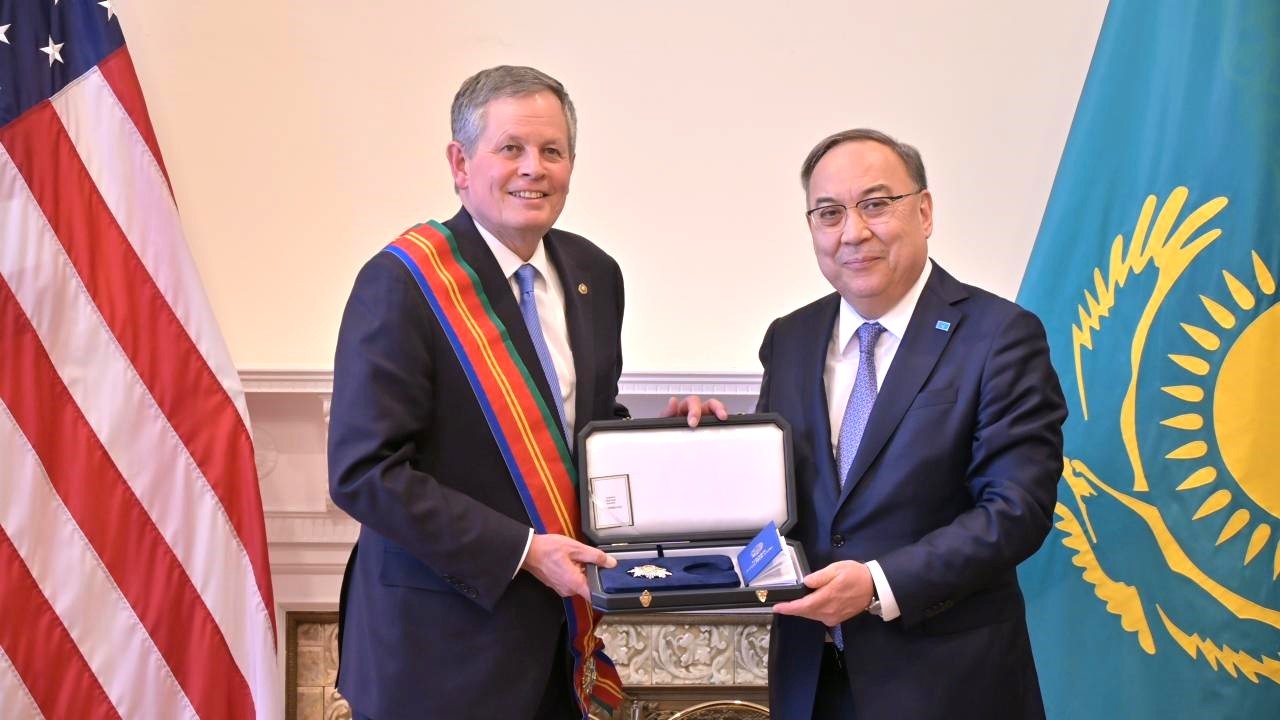
Special Representative for Negotiations with the United States, Erzhan Kazykhan, presents Senator Steve Daines with the Order of Dostyk (Friendship); image: gov.kz
Kazykhan also met with Representative Bill Huizenga, chairman of the House Foreign Affairs Subcommittee covering South and Central Asia, in another sign that the visit was aimed at strengthening ties not only with the administration but with Congress as well.
Kazykhan described relations between Kazakhstan and the U.S. as being at their “highest point in the history of bilateral engagement.” The Kazakh side also highlighted Daines’ role in interparliamentary cooperation, including his support for the Central Asia Caucus in Congress, backing for efforts to repeal the Jackson-Vanik amendment, and support for Senate recognition of the strategic importance of the C5+1 platform. In February, Kazakhstan’s Foreign Ministry also said Daines had emphasized the need for favorable legislative conditions in Congress to expand bilateral business ties, including through Permanent Normal Trade Relations, and said work toward repealing Jackson-Vanik was underway.
This was a visit with layers, not solely about one meeting with the Secretary of State. It also showed Astana tending to its ties on Capitol Hill as trade status, congressional caucus work, and the wider direction of U.S.-Central Asia relations remain in play. Kazakhstan is trying to keep its Washington ties broad, with support in diplomacy, business, and Congress rather than relying on a single channel.
For the United States, the message is equally clear. Kazakhstan remains an important Central Asian partner in a region that has become increasingly important because of transit routes, energy, critical minerals, and its place in a changing Eurasian landscape. For Kazakhstan, the Rubio meeting offered another chance to show that its relationship with Washington is not merely formal. It is part of a larger effort to turn political contact into practical economic cooperation.