
Pannier and Hillard’s Spotlight on Central Asia: New Episode Out Now
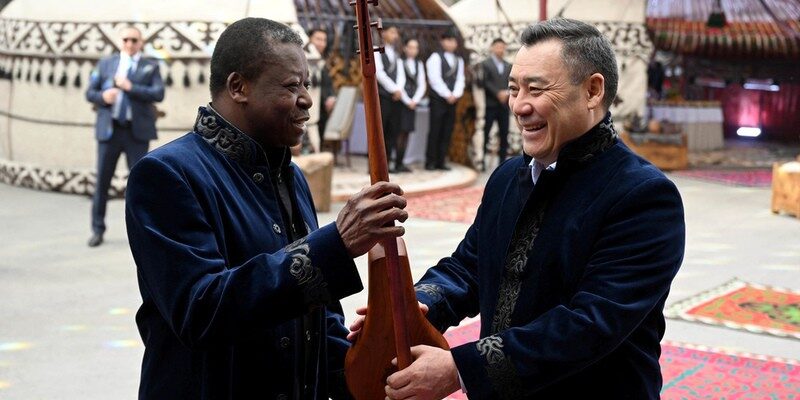
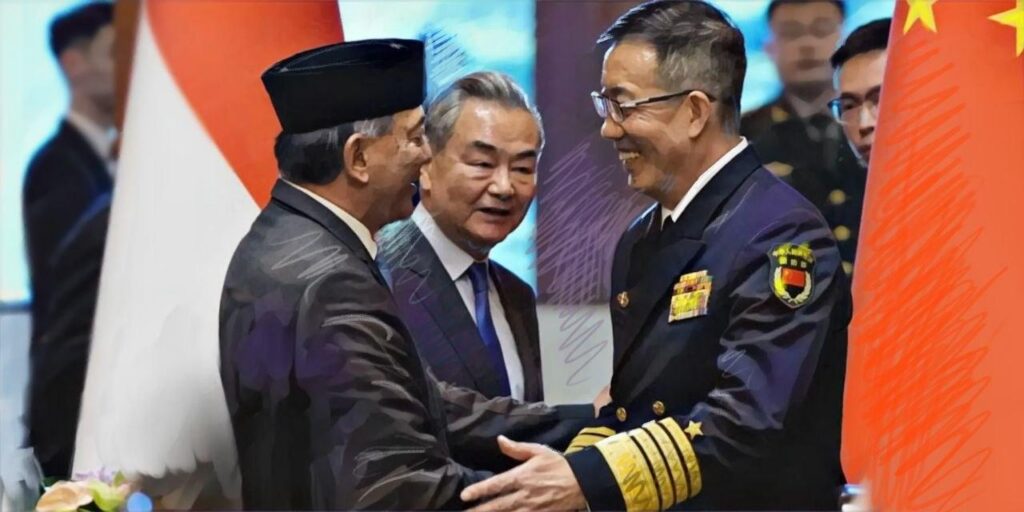
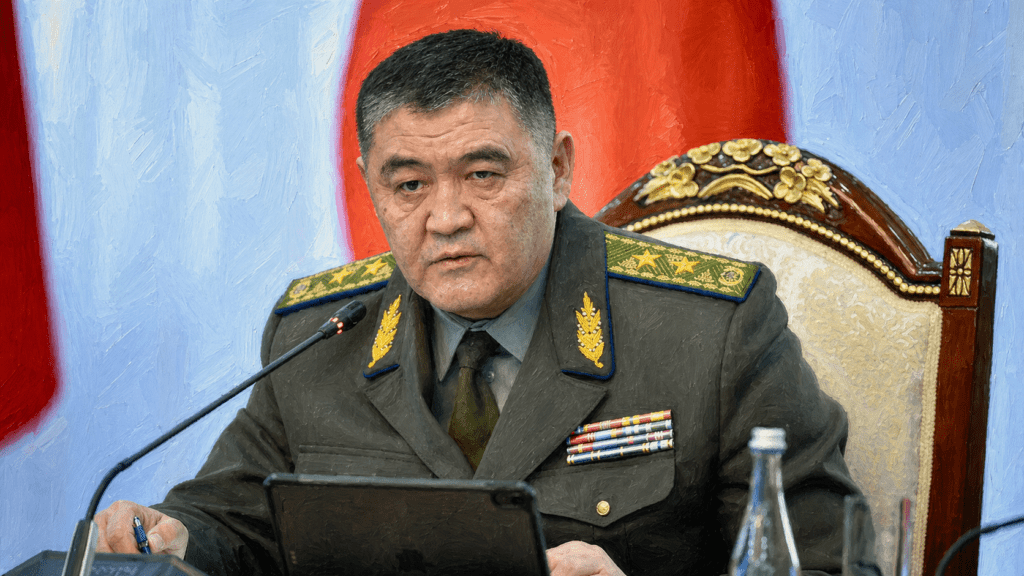
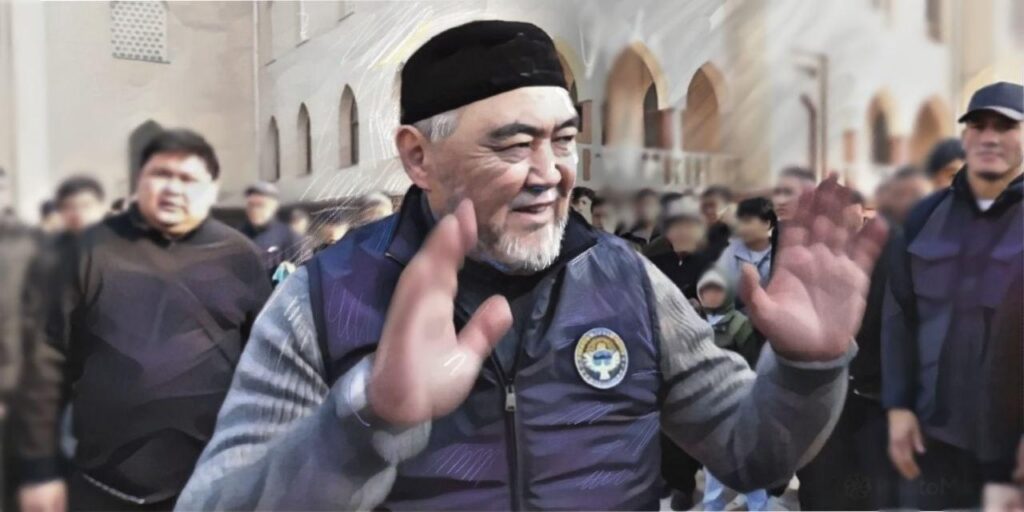
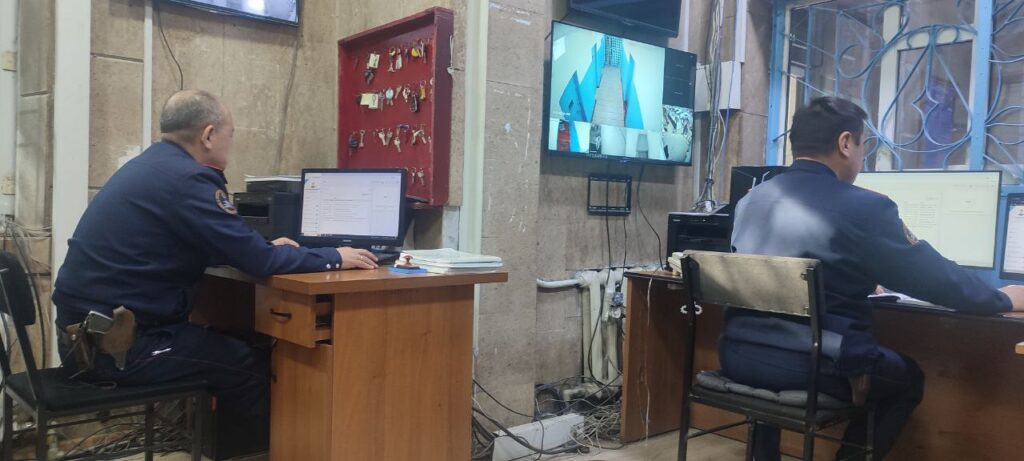
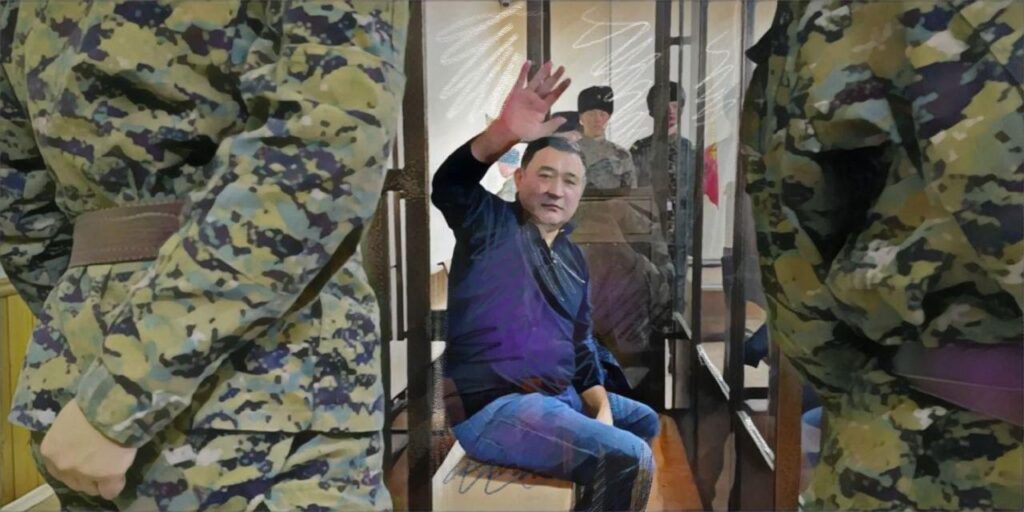
As Managing Editor of The Times of Central Asia, I’m delighted that, in partnership with the Oxus Society for Central Asian Affairs, from October 19, we are the home of the Spotlight on Central Asia podcast. Chaired by seasoned broadcasters Bruce Pannier of RFE/RL’s long-running Majlis podcast and Michael Hillard of The Red Line, each fortnightly instalment will take you on a deep dive into the latest news, developments, security issues, and social trends across an increasingly pivotal region. This week, the team will be covering the highly successful OTS summit in Turkistan, alongside Putin's notably bad day at the Moscow Victory Day parade. We'll also break down the new ships launching in the Caspian Sea and what they signal for cross-Caspian trade, a long-awaited move from Kyrgyzstan's Prosecutor General that we've been tracking for months, another serious shootout involving counter-narcotics forces in Afghanistan, and Emomali Rahmon's trip to Beijing for talks with the Chinese leadership. And for our main story, we turn to Tajikistan's heir apparent, Rustam Emomali, the man widely tipped to become the country's next president On the show this week: - Salim Ayoubzod (Radio Free Liberty) - Edward Lemon (The Oxus Society for Central Asian Affairs)
Erdoğan Visit Puts Trade, Transit, and Turkic Economic Integration at Center of Kazakhstan’s OTS Push
Turkish President Recep Tayyip Erdoğan’s visit to Kazakhstan comes as Astana is trying to give the Organization of Turkic States a more practical economic role, linking trade, investment, transport, digital development, and business financing across the Turkic world.
The visit centered on three connected events: Erdoğan’s official visit to Astana, the sixth meeting of the Kazakhstan-Turkey High-Level Strategic Cooperation Council, and the informal summit of the Organization of Turkic States in Turkistan. Erdoğan arrived in Astana ahead of talks with President Kassym-Jomart Tokayev, while Turkish media reported that the agenda included transport links through the Middle Corridor, Caspian transit routes, energy security, logistics, defense industry cooperation, trade and investment.
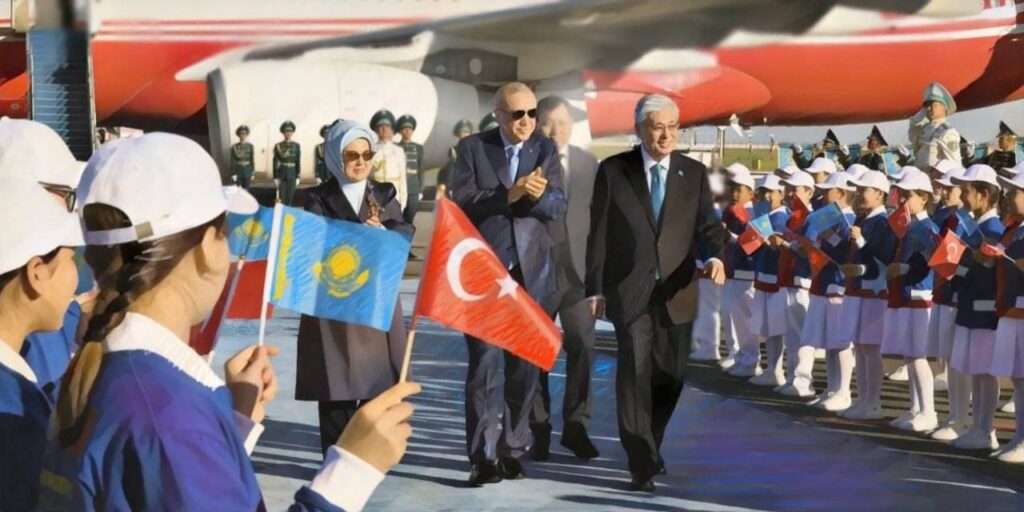
The visit also carried strong symbolic staging. According to Akorda, Erdoğan’s aircraft was escorted by Kazakh Air Defense fighter jets after entering Kazakhstan’s airspace. At Astana airport, he was greeted by an honor guard, children waving the flags of Kazakhstan and Turkey, and military helicopters displaying the national symbols of both countries. Erdoğan later said the welcome had brought his delegation “enormous joy,” adding, “We certainly will not forget this.”
[caption id="attachment_48862" align="aligncenter" width="1280"]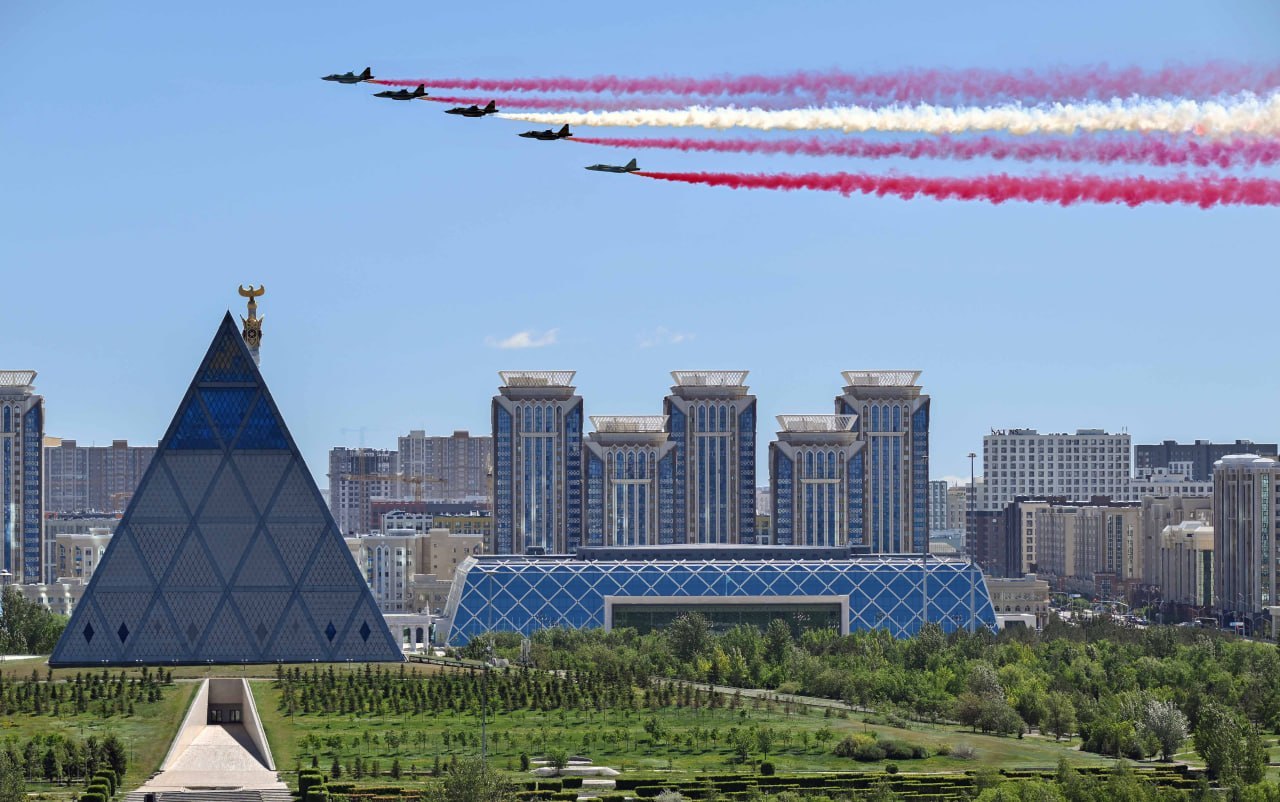 Kazakh aircraft fly over Astana during the ceremonial welcome for Erdoğan. Image: Akorda[/caption]
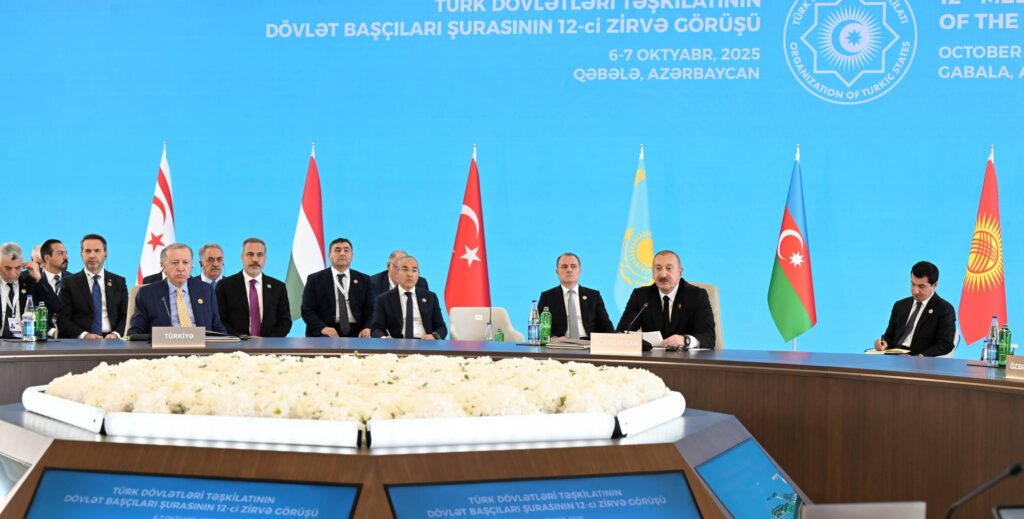
The OTS summit is being hosted by Kazakhstan on May 15 in Turkistan under the theme “Artificial Intelligence and Digital Development.” According to the organization, the summit is intended to advance cooperation on artificial intelligence, digital innovation, emerging technologies, public services, sustainable economic growth, and regional connectivity.
The digital theme reflects Kazakhstan’s effort to give the OTS a more practical economic role, beyond its cultural and diplomatic foundations. Ahead of the summit, Astana hosted a business forum on May 13 under the title “Economic Integration and Cooperation of the OTS Countries: New Opportunities in Industry, Agro-Industrial Complex, Logistics and Digitalization.” Kazakhstan’s prime minister’s office said the forum brought together state bodies, financial institutions, chambers of commerce, international organizations, and business representatives from OTS countries.
Kanat Sharlapayev, chairman of the Union of Chambers of Commerce and Industry of Turkic States and of the presidium of Kazakhstan’s Atameken National Chamber of Entrepreneurs, urged Turkic countries to move toward deeper industrial and digital integration. He said the task was to create a unified digital environment, reduce the distance between producers and consumers, increase transparency, and speed up transactions.
The forum also discussed plans for joint industrial facilities and manufacturing zones along transport corridors, an idea that would push OTS cooperation beyond transit toward processing and value-added production.
Deputy Prime Minister and Minister of National Economy Serik Zhumangarin used the forum to frame OTS cooperation as one of Kazakhstan’s foreign economic priorities. He said the OTS countries form a market of more than 170 million people and have significant industrial, transport, agricultural, and human potential. He also said the main task was to move from declarations to joint projects, new production, technology alliances, and mutual investment.
Silk Way TV reported that Murat Karimsakov, chairman of the Kazakh Chamber of International Commerce, said trade turnover among OTS countries increased by more than 36% in 2025, while direct investment from Turkic states into Kazakhstan reached nearly half a billion dollars. Karimsakov also said Turkish investment in Kazakhstan had exceeded $6 billion over the past 20 years.
The trade target remains ambitious. At the council meeting in Astana, Erdoğan said Kazakhstan and Turkey had reaffirmed their goal of raising bilateral trade turnover to $15 billion. He also emphasized the importance of implementing the action plan adopted at the 14th meeting of the Joint Economic Cooperation Commission, held in Astana on April 15. The April commission meeting had already pointed to the practical areas behind the new trade push. The Times of Central Asia previously reported that Kazakhstan was seeking to expand agricultural exports to Turkey, with the two sides discussing trade in grain, oilseeds, livestock products, sugar, confectionery, and processed foods.
Tokayev placed the investment relationship in similar terms, stating that Turkish investment in Kazakhstan had reached $6 billion, while Kazakh investment in Turkey had approached $2.5 billion. He also described Turkey as one of Kazakhstan’s top five trading partners and said the two countries would sign a Declaration on Eternal Friendship and Expanded Strategic Partnership.
The business forum gave that political language a more practical layer. Kazakhstan’s Atameken National Chamber of Entrepreneurs signed an agreement with the Turkic Investment Fund aimed at expanding investment cooperation and supporting joint projects. A separate memorandum was signed between the Union of Chambers of Commerce and Industry of Turkic States, Kazakhstan’s Foreign Trade Chamber, and the National Association of Cooperatives and Other Economic Communities.
The Turkic Investment Fund is central to that effort. Kazakhstan views the fund as one of the main financial mechanisms for supporting joint OTS projects. Zhumangarin said the fund was ready to allocate at least $20 million at the initial stage for co-financing projects, and that talks were underway on possible participation in financing infrastructure development at Almaty International Airport.
For Kazakhstan, the OTS connects bilateral ties with Turkey to a wider regional corridor. The organization’s members are Turkey, Azerbaijan, Kazakhstan, Kyrgyzstan, and Uzbekistan. Its observer states are Hungary, Turkmenistan, and the Turkish Republic of Northern Cyprus, while the Economic Cooperation Organization has observer organization status.
This gives the OTS a geographic logic that is increasingly economic as well as cultural and political. It links Central Asia with Azerbaijan and Turkey across the Caspian, overlapping with Kazakhstan’s long-running effort to expand the Trans-Caspian International Transport Route, often called the Middle Corridor. Azerbaijan is the pivotal Caspian link in Kazakhstan’s westward corridor to the South Caucasus and Europe, with Astana also pursuing Caspian fiber-optic and power-cable projects alongside transport cooperation.
Zhumangarin separately highlighted the importance of sustainable transport routes, including the modernization of rail and port infrastructure to expand transit and trade between East and West.
Transport and logistics remain the key test. Kazakhstan wants more reliable export and transit options across the Caspian, while Turkey wants to strengthen its role as the western gateway for goods moving between Central Asia, the Caucasus, and Europe. The business forum’s focus on logistics shows the OTS economic agenda is now being tied directly to corridor development rather than solely to identity politics or diplomatic language.
Energy is part of the same corridor question, with energy security expected to feature prominently in the discussions. Any increase in Caspian-linked exports depends not only on political will, but also on port capacity, rail connections, pipeline standards, financing, and predictable customs procedures.
The visit also carries a cultural and humanitarian layer. Qazinform, citing Akorda, reported that Kazakhstan has built a school named after Khoja Ahmed Yassawi in Turkey’s Gaziantep province, which was affected by the 2023 earthquake. The two sides also agreed to open Maarif Foundation schools in Astana and Almaty. Around 14,000 Kazakh students are currently studying in Turkey, while about 260 Turkish students are studying in Kazakhstan.
Tokayev also said the newly established Khoja Ahmed Yassawi Order would be awarded to Erdoğan in recognition of his contribution to strengthening bilateral cooperation. The award reinforces the symbolic side of the visit, particularly because the OTS summit is being held in Turkistan, a city closely associated with Yassawi’s legacy.
[caption id="attachment_48859" align="aligncenter" width="2560"]
Kazakh aircraft fly over Astana during the ceremonial welcome for Erdoğan. Image: Akorda[/caption]
The OTS summit is being hosted by Kazakhstan on May 15 in Turkistan under the theme “Artificial Intelligence and Digital Development.” According to the organization, the summit is intended to advance cooperation on artificial intelligence, digital innovation, emerging technologies, public services, sustainable economic growth, and regional connectivity.
The digital theme reflects Kazakhstan’s effort to give the OTS a more practical economic role, beyond its cultural and diplomatic foundations. Ahead of the summit, Astana hosted a business forum on May 13 under the title “Economic Integration and Cooperation of the OTS Countries: New Opportunities in Industry, Agro-Industrial Complex, Logistics and Digitalization.” Kazakhstan’s prime minister’s office said the forum brought together state bodies, financial institutions, chambers of commerce, international organizations, and business representatives from OTS countries.
Kanat Sharlapayev, chairman of the Union of Chambers of Commerce and Industry of Turkic States and of the presidium of Kazakhstan’s Atameken National Chamber of Entrepreneurs, urged Turkic countries to move toward deeper industrial and digital integration. He said the task was to create a unified digital environment, reduce the distance between producers and consumers, increase transparency, and speed up transactions.
The forum also discussed plans for joint industrial facilities and manufacturing zones along transport corridors, an idea that would push OTS cooperation beyond transit toward processing and value-added production.
Deputy Prime Minister and Minister of National Economy Serik Zhumangarin used the forum to frame OTS cooperation as one of Kazakhstan’s foreign economic priorities. He said the OTS countries form a market of more than 170 million people and have significant industrial, transport, agricultural, and human potential. He also said the main task was to move from declarations to joint projects, new production, technology alliances, and mutual investment.
Silk Way TV reported that Murat Karimsakov, chairman of the Kazakh Chamber of International Commerce, said trade turnover among OTS countries increased by more than 36% in 2025, while direct investment from Turkic states into Kazakhstan reached nearly half a billion dollars. Karimsakov also said Turkish investment in Kazakhstan had exceeded $6 billion over the past 20 years.
The trade target remains ambitious. At the council meeting in Astana, Erdoğan said Kazakhstan and Turkey had reaffirmed their goal of raising bilateral trade turnover to $15 billion. He also emphasized the importance of implementing the action plan adopted at the 14th meeting of the Joint Economic Cooperation Commission, held in Astana on April 15. The April commission meeting had already pointed to the practical areas behind the new trade push. The Times of Central Asia previously reported that Kazakhstan was seeking to expand agricultural exports to Turkey, with the two sides discussing trade in grain, oilseeds, livestock products, sugar, confectionery, and processed foods.
Tokayev placed the investment relationship in similar terms, stating that Turkish investment in Kazakhstan had reached $6 billion, while Kazakh investment in Turkey had approached $2.5 billion. He also described Turkey as one of Kazakhstan’s top five trading partners and said the two countries would sign a Declaration on Eternal Friendship and Expanded Strategic Partnership.
The business forum gave that political language a more practical layer. Kazakhstan’s Atameken National Chamber of Entrepreneurs signed an agreement with the Turkic Investment Fund aimed at expanding investment cooperation and supporting joint projects. A separate memorandum was signed between the Union of Chambers of Commerce and Industry of Turkic States, Kazakhstan’s Foreign Trade Chamber, and the National Association of Cooperatives and Other Economic Communities.
The Turkic Investment Fund is central to that effort. Kazakhstan views the fund as one of the main financial mechanisms for supporting joint OTS projects. Zhumangarin said the fund was ready to allocate at least $20 million at the initial stage for co-financing projects, and that talks were underway on possible participation in financing infrastructure development at Almaty International Airport.
For Kazakhstan, the OTS connects bilateral ties with Turkey to a wider regional corridor. The organization’s members are Turkey, Azerbaijan, Kazakhstan, Kyrgyzstan, and Uzbekistan. Its observer states are Hungary, Turkmenistan, and the Turkish Republic of Northern Cyprus, while the Economic Cooperation Organization has observer organization status.
This gives the OTS a geographic logic that is increasingly economic as well as cultural and political. It links Central Asia with Azerbaijan and Turkey across the Caspian, overlapping with Kazakhstan’s long-running effort to expand the Trans-Caspian International Transport Route, often called the Middle Corridor. Azerbaijan is the pivotal Caspian link in Kazakhstan’s westward corridor to the South Caucasus and Europe, with Astana also pursuing Caspian fiber-optic and power-cable projects alongside transport cooperation.
Zhumangarin separately highlighted the importance of sustainable transport routes, including the modernization of rail and port infrastructure to expand transit and trade between East and West.
Transport and logistics remain the key test. Kazakhstan wants more reliable export and transit options across the Caspian, while Turkey wants to strengthen its role as the western gateway for goods moving between Central Asia, the Caucasus, and Europe. The business forum’s focus on logistics shows the OTS economic agenda is now being tied directly to corridor development rather than solely to identity politics or diplomatic language.
Energy is part of the same corridor question, with energy security expected to feature prominently in the discussions. Any increase in Caspian-linked exports depends not only on political will, but also on port capacity, rail connections, pipeline standards, financing, and predictable customs procedures.
The visit also carries a cultural and humanitarian layer. Qazinform, citing Akorda, reported that Kazakhstan has built a school named after Khoja Ahmed Yassawi in Turkey’s Gaziantep province, which was affected by the 2023 earthquake. The two sides also agreed to open Maarif Foundation schools in Astana and Almaty. Around 14,000 Kazakh students are currently studying in Turkey, while about 260 Turkish students are studying in Kazakhstan.
Tokayev also said the newly established Khoja Ahmed Yassawi Order would be awarded to Erdoğan in recognition of his contribution to strengthening bilateral cooperation. The award reinforces the symbolic side of the visit, particularly because the OTS summit is being held in Turkistan, a city closely associated with Yassawi’s legacy.
[caption id="attachment_48859" align="aligncenter" width="2560"]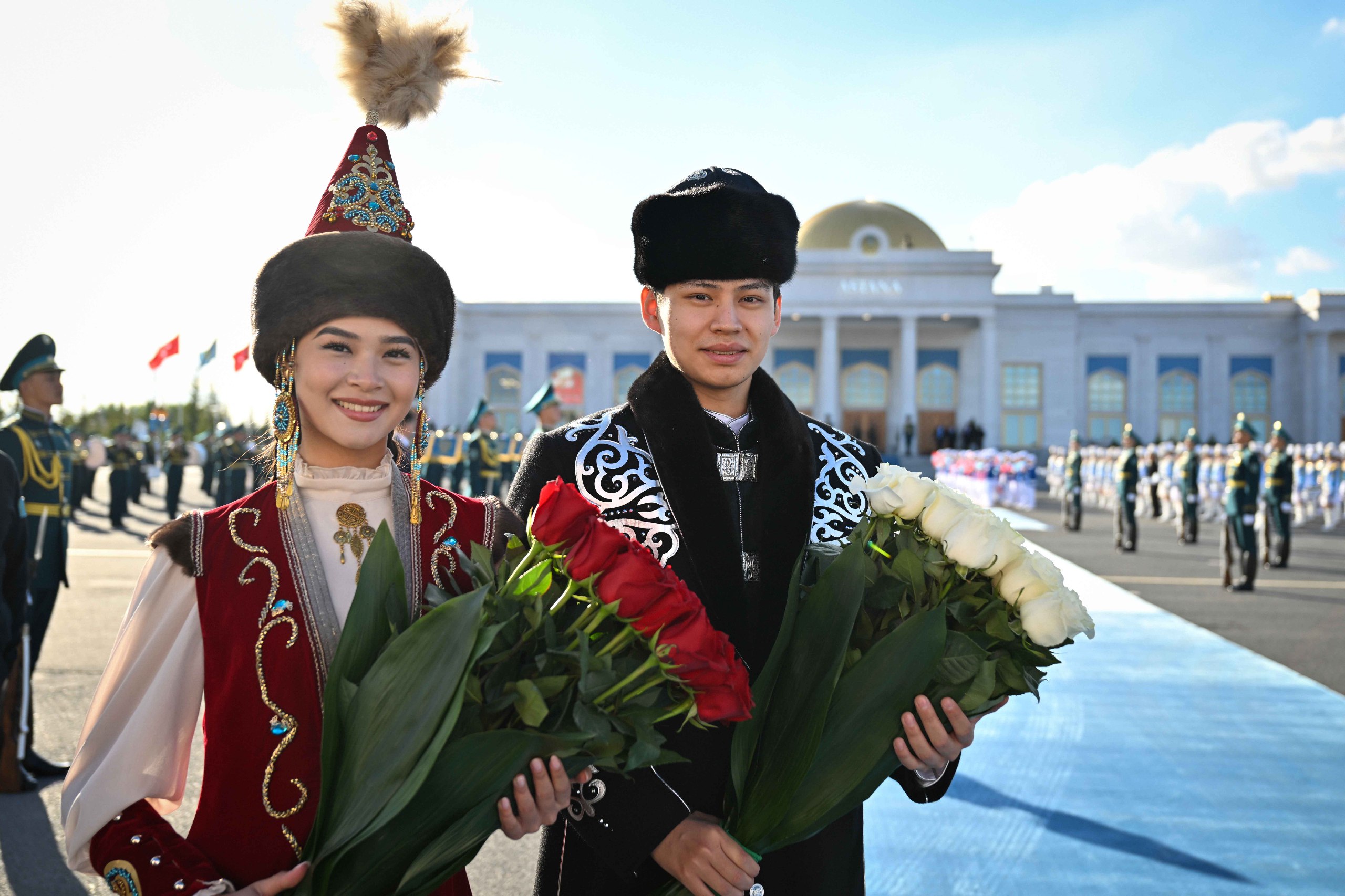 Ceremonial welcome for Erdoğan in Astana. Image: Akorda[/caption]
The symbolism of the visit carries weight, but the larger question is whether the organization can turn shared identity into a working economic infrastructure. For Kazakhstan and Turkey, that means fewer declarations and more usable routes, financing tools, customs links, and projects that businesses can actually rely on.
Erdoğan’s visit does not settle that question, but it shows where Astana wants the OTS to go. The organization is being framed less as a cultural club and more as a platform for trade, transit, investment, and digital cooperation. Whether that platform can deliver will depend on what follows after the summit: signed projects, funded corridors, and simpler movement of goods across the Caspian.
Ceremonial welcome for Erdoğan in Astana. Image: Akorda[/caption]
The symbolism of the visit carries weight, but the larger question is whether the organization can turn shared identity into a working economic infrastructure. For Kazakhstan and Turkey, that means fewer declarations and more usable routes, financing tools, customs links, and projects that businesses can actually rely on.
Erdoğan’s visit does not settle that question, but it shows where Astana wants the OTS to go. The organization is being framed less as a cultural club and more as a platform for trade, transit, investment, and digital cooperation. Whether that platform can deliver will depend on what follows after the summit: signed projects, funded corridors, and simpler movement of goods across the Caspian.
Opinion: A New Southern Gate – How the EU-Armenia Summit Unlocks a Critical Branch for the Middle Corridor
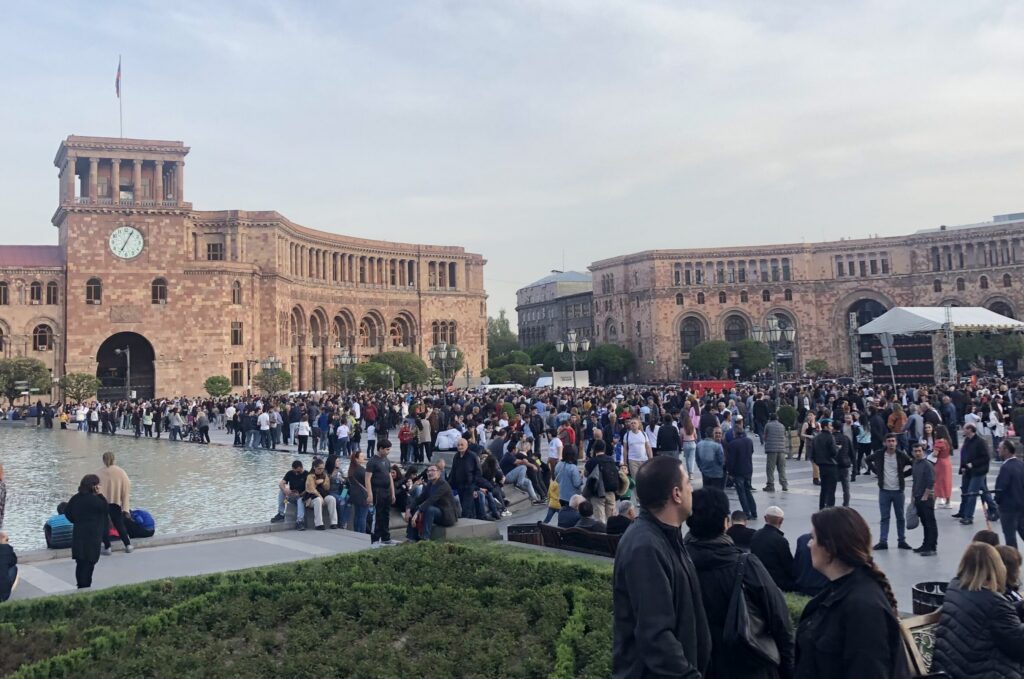
For the first time in its history, the European Union held a full summit with Armenia. The meeting, which took place in Yerevan on 4–5 May 2026, was not merely a diplomatic milestone for Armenia. It also sent a signal to governments thousands of kilometers away in Central Asia that the trade route linking Asia to Europe through the South Caucasus is becoming more real, and more politically backed, than ever before.
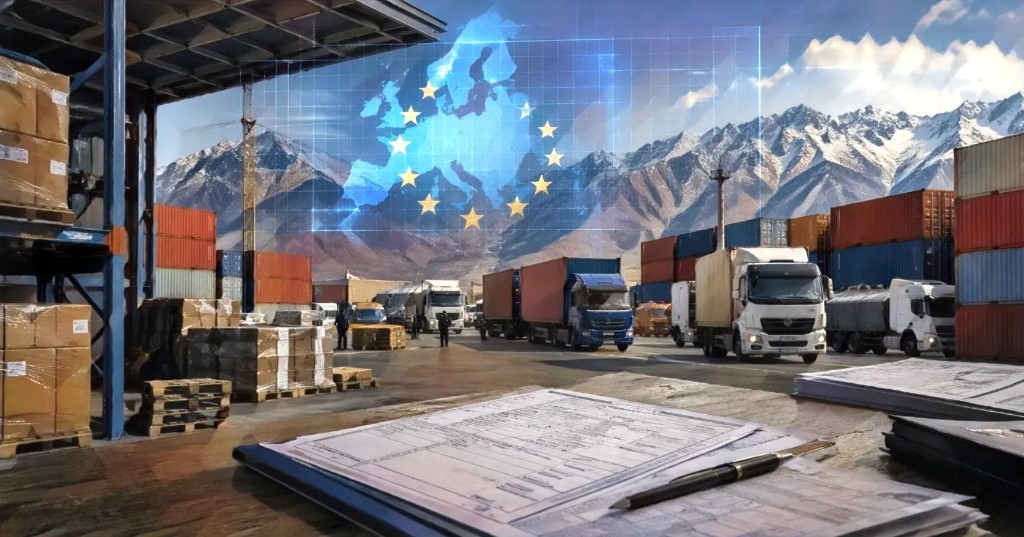
The centerpiece of the summit saw the signing of a “Connectivity Partnership” between Brussels and Yerevan. The European Commission President, Ursula von der Leyen, described Armenia as "uniquely positioned" to connect Europe with the South Caucasus and Central Asia. Under the EU's Global Gateway program, investments in Armenia are expected to reach €2.5 billion. A further €3 billion is earmarked specifically for the Middle Corridor – the trade route that runs from China across Central Asia, over the Caspian Sea, through the South Caucasus, and into Europe.
“We will support your integration into key transport networks like the Trans-Caspian Corridor. It is a route that is also of strategic importance for Europe, given the growing flows of trade between our two regions,” von der Leyen stated.
A Route That Is Already Moving Fast
The Middle Corridor, formally known as the Trans-Caspian International Transport Route (TITR), has grown at a pace that few predicted. Cargo volumes rose 70 percent in the first nine months of 2024 alone, reaching 3.4 million tons. By the end of that year, the total had climbed to 4.1 million tons – up from just 350,000 tons in 2021. The World Bank projects that the route could handle up to 11 million tonnes a year by 2030.
It's important to maintain some perspective. These numbers are small fry when compared to the billions of tons of trade that moves between Europe and Asia by sea. However, the Middle Corridor does offer important diversification, particularly given the spillover effects of wars in the Middle East and piracy in the Red Sea.
[caption id="attachment_48602" align="aligncenter" width="1274"]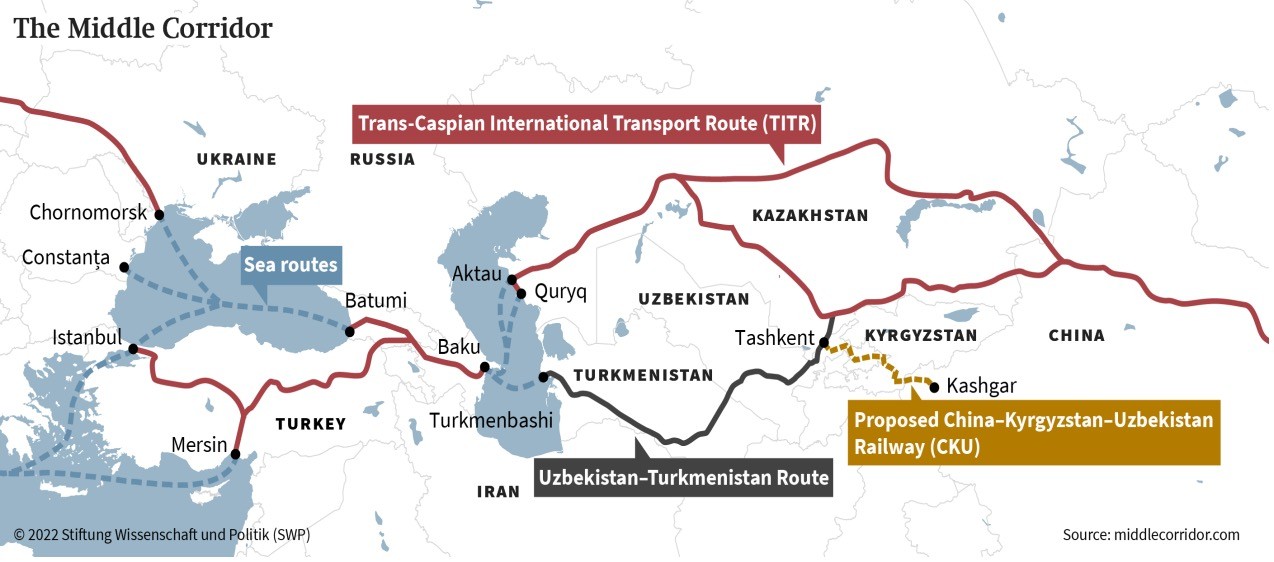 Image: Trans Caspian International Transport Route and it’s southern part, China-Kyrgyzstan-Uzbekistan Railway project. Source: middlecorridor.com[/caption]
Where Uzbekistan Stands
For Uzbekistan, the Middle Corridor is both an opportunity and a work in progress. In January 2025, President Mirziyoyev signed a decree to upgrade road and rail connectivity, and in September 2024, Tashkent co-founded the Eurasian Transport Route Association alongside Austria, Azerbaijan, China, Kyrgyzstan, Tajikistan, and Turkey. In December 2024, Uzbekistan sent its first block train all the way to Brazil – through Turkmenistan, Azerbaijan, and the Georgian port of Poti – proving the route is operationally viable.
But costs remain a challenge. Shipping a 40-foot container via the Middle Corridor currently costs between $3,500 and $4,500, compared to $2,800–$3,200 on the Northern Corridor through Russia. Europe, meanwhile, accounts for only around 3 percent of Uzbekistan's exports and 13 percent of its imports — a share that Tashkent wants to grow significantly.
The China–Kyrgyzstan–Uzbekistan (CKU) railway — a $8 billion, 573-kilometre project whose joint construction company was established in July 2024 — is the most consequential single piece of infrastructure in play. Once complete, it will give Uzbekistan an alternative means to access China by rail, bypassing Kazakhstan. As a 2025 analysis by Trends Research noted, the CKU will reduce transit time between China and Europe and lower export costs for the Fergana Valley — Uzbekistan's industrial heartland.
Where Armenia Fits In
For three decades, Yerevan has been cut off from regional logistics networks after Azerbaijan and Turkey closed their borders in the early 1990s. The EU summit this week marks the clearest signal yet that this isolation is ending.
Armenian Foreign Minister Ararat Mirzoyan, speaking at an EU connectivity ministerial in Luxembourg last October, framed the stakes directly: "Being at the crossroads, Armenia can play a crucial role in the chain connecting Europe, the South Caucasus, and Central Asia." He also echoed von der Leyen's earlier assessment that opening Armenia's borders with Azerbaijan and Turkey would be, in the Commission President's words, a "game-changer" for the entire corridor.
Such an endeavor is likely to be contingent on the Armenian elections, which take place on June 7. Current Prime Minister Nikol Pashinyan is bidding to earn himself a two-thirds majority in the country’s parliament, which will enable him to change the constitution to remove Armenia's claims on the Azerbaijani territory of Nagorno-Karabakh. Azerbaijan has made this a prerequisite for any final agreement on opening the TRIPP route through Armenia.
But he has his work cut out to achieve this. Russia has acted in its traditional role of spoiler, funneling money to various opposition parties in order to try to keep Armenia within its orbit.
Should Pashinyan prevail, the combined southern route, combining the China-Kyrgyzstan-Uzbekistan railway and the TRIPP corridor through Armenia, could allow cargo to be transported from Kashgar to European markets in about 10-14 days – about 900 kilometers shorter than the existing northern routes – which could reduce land costs per container by 20-30 percent compared to current prices.
It's a prize that many in Central Asia are quietly hoping for.
The views expressed in this article are those of the author and do not necessarily reflect the official policy or position of the publication, its affiliates, or any other organizations mentioned.
Image: Trans Caspian International Transport Route and it’s southern part, China-Kyrgyzstan-Uzbekistan Railway project. Source: middlecorridor.com[/caption]
Where Uzbekistan Stands
For Uzbekistan, the Middle Corridor is both an opportunity and a work in progress. In January 2025, President Mirziyoyev signed a decree to upgrade road and rail connectivity, and in September 2024, Tashkent co-founded the Eurasian Transport Route Association alongside Austria, Azerbaijan, China, Kyrgyzstan, Tajikistan, and Turkey. In December 2024, Uzbekistan sent its first block train all the way to Brazil – through Turkmenistan, Azerbaijan, and the Georgian port of Poti – proving the route is operationally viable.
But costs remain a challenge. Shipping a 40-foot container via the Middle Corridor currently costs between $3,500 and $4,500, compared to $2,800–$3,200 on the Northern Corridor through Russia. Europe, meanwhile, accounts for only around 3 percent of Uzbekistan's exports and 13 percent of its imports — a share that Tashkent wants to grow significantly.
The China–Kyrgyzstan–Uzbekistan (CKU) railway — a $8 billion, 573-kilometre project whose joint construction company was established in July 2024 — is the most consequential single piece of infrastructure in play. Once complete, it will give Uzbekistan an alternative means to access China by rail, bypassing Kazakhstan. As a 2025 analysis by Trends Research noted, the CKU will reduce transit time between China and Europe and lower export costs for the Fergana Valley — Uzbekistan's industrial heartland.
Where Armenia Fits In
For three decades, Yerevan has been cut off from regional logistics networks after Azerbaijan and Turkey closed their borders in the early 1990s. The EU summit this week marks the clearest signal yet that this isolation is ending.
Armenian Foreign Minister Ararat Mirzoyan, speaking at an EU connectivity ministerial in Luxembourg last October, framed the stakes directly: "Being at the crossroads, Armenia can play a crucial role in the chain connecting Europe, the South Caucasus, and Central Asia." He also echoed von der Leyen's earlier assessment that opening Armenia's borders with Azerbaijan and Turkey would be, in the Commission President's words, a "game-changer" for the entire corridor.
Such an endeavor is likely to be contingent on the Armenian elections, which take place on June 7. Current Prime Minister Nikol Pashinyan is bidding to earn himself a two-thirds majority in the country’s parliament, which will enable him to change the constitution to remove Armenia's claims on the Azerbaijani territory of Nagorno-Karabakh. Azerbaijan has made this a prerequisite for any final agreement on opening the TRIPP route through Armenia.
But he has his work cut out to achieve this. Russia has acted in its traditional role of spoiler, funneling money to various opposition parties in order to try to keep Armenia within its orbit.
Should Pashinyan prevail, the combined southern route, combining the China-Kyrgyzstan-Uzbekistan railway and the TRIPP corridor through Armenia, could allow cargo to be transported from Kashgar to European markets in about 10-14 days – about 900 kilometers shorter than the existing northern routes – which could reduce land costs per container by 20-30 percent compared to current prices.
It's a prize that many in Central Asia are quietly hoping for.
The views expressed in this article are those of the author and do not necessarily reflect the official policy or position of the publication, its affiliates, or any other organizations mentioned.
No Tanks on Red Square as Moscow’s Victory Day Pull Fades in Central Asia
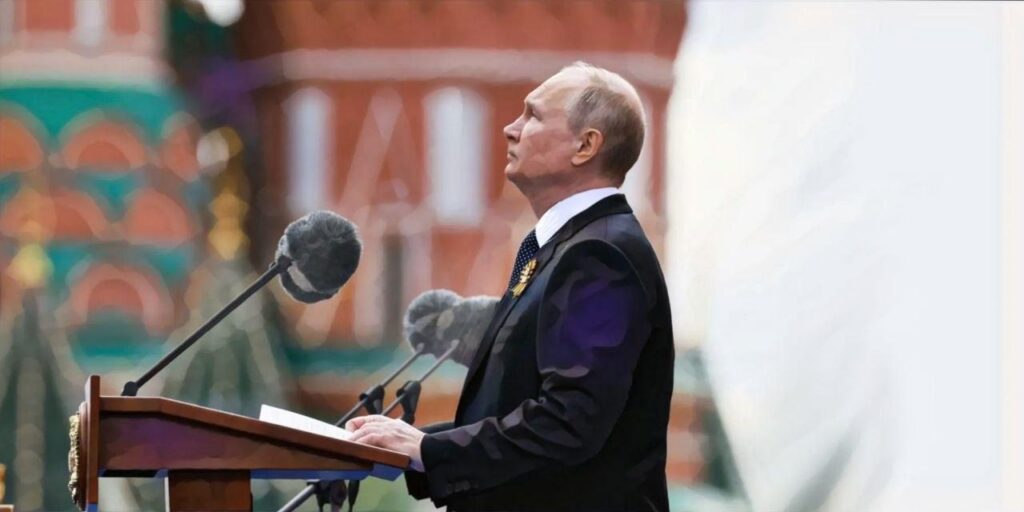
Russia’s Victory Day parade on May 9 is set to be more restrained this year, with tanks, armored vehicles, and missile systems absent from Red Square for the first time in nearly two decades. The Russian Defense Ministry cited the “current operational situation,” while the Kremlin blamed what it called Ukrainian “terrorist activity.” Russia also reported drone attacks aimed at Moscow in the days before the ceremony, and security around President Vladimir Putin has been tightened. The reduced scale of the parade carries a resonance beyond Russia. Victory Day remains one of the most emotionally charged dates in the post-Soviet calendar, including in Central Asia, where families still remember relatives who fought, died, or labored during World War II. But across the region, the holiday has increasingly been placed inside national calendars rather than left as part of Russia’s political script. The contrast with last year is sharp. In 2025, Moscow marked the 80th anniversary of Nazi Germany’s defeat with its largest Victory Day parade since the start of Russia’s full-scale invasion of Ukraine. Chinese troops marched on Red Square, Xi Jinping sat beside Putin, and foreign leaders attended from across Asia, Africa, Latin America, and the former Soviet space. Tanks, rocket launchers, missile systems, drones, and other military hardware rolled through the square. This year’s guest list is more limited. The Kremlin’s initial list of foreign delegations included leaders and senior figures from Belarus, Laos, Malaysia, Slovakia, the breakaway republics of Abkhazia and South Ossetia, and representatives from Bosnia and Herzegovina’s Republika Srpska. Attendance has also been hard to read. Earlier reports said Kazakhstan’s Kassym-Jomart Tokayev and Kyrgyzstan’s Sadyr Japarov were expected in Moscow, while the Kremlin’s initial published list of foreign guests did not include any Central Asian presidents. On May 8, however, Kazakh and Uzbek media reported that Tokayev and Uzbekistan’s Shavkat Mirziyoyev were traveling to Moscow for Victory Day events. The late confirmations complicate the picture, but they do not restore the full regional show of unity seen in the last two years, when all five Central Asian presidents were present at the Moscow parade. It does suggest, however, that Moscow’s political ownership of the date is less automatic than it once was. Victory Day, which commemorates the Soviet defeat of Nazi Germany in what Russia calls the Great Patriotic War, has long been one of the main rituals of modern Russian power. It draws large television audiences, fills public space with military symbolism, and presents the Kremlin as the guardian of a sacred national memory. The holiday speaks of sacrifice and family loss, but also of nationalism and state control over history. Putin has used that language repeatedly. On May 9, 2024, after appearing on Red Square in snowfall, he said Russia was going through a “difficult, milestone period,” and warned: “We will not allow anyone to threaten us. Our strategic forces are always in combat readiness.” In 2025, he used the 80th anniversary parade to link Soviet wartime memory to Russia’s current war, saying that “truth and justice” were on Moscow’s side. In Central Asia, the Soviet past has been handled more cautiously. Streets have been renamed, statues have been moved, and monuments to Soviet leaders have often lost their central place. In Kazakhstan, Lenin statues still exist, especially in regions with large ethnic Russian populations, but their number has fallen sharply since independence. The Times of Central Asia previously reported that, as of 2017, 159 Lenin statues remained in Kazakhstan, while 341 had been demolished since the fall of the Soviet Union. The debate has continued elsewhere in the region: in 2025, the removal of a 23-meter-tall Lenin monument in Osh, once the tallest in Central Asia, prompted public discussion in Kyrgyzstan and criticism from Russian media. In Russia, the movement has often run in the opposite direction. In Volgograd, formerly Stalingrad, a new bust of Josef Stalin was unveiled in 2023 ahead of the 80th anniversary of the Soviet victory at Stalingrad. In Moscow, a recreated Stalin monument returned to the Taganskaya metro station in 2025. These gestures do not simply restore old symbols. They place Stalin back inside a state-approved story of wartime victory, strength, and sacrifice, while keeping the terror of his rule in the background. The legal framework has moved in the same direction. Russia’s 2020 constitutional amendments state that the Russian Federation honors the memory of defenders of the Fatherland and protects historical truth. They also state that diminishing the significance of the people’s heroism in defending the Fatherland is not permitted, giving the state a constitutional basis for policing how World War II and Soviet victory are discussed. That message depends on a selective version of the past. The clearest example is the Molotov-Ribbentrop Pact of August 1939. The public agreement was a nonaggression pact between Nazi Germany and the Soviet Union, while its secret protocol divided parts of Eastern Europe into German and Soviet spheres of influence and paved the way for the partition of Poland. The Soviet Union denied the secret protocol for decades and acknowledged it only during glasnost, when the Congress of People’s Deputies condemned the pact in 1989. This history sits uneasily beside the official mythology of the Great Patriotic War. The Soviet Union suffered catastrophic losses after Hitler launched Operation Barbarossa in June 1941. Around 27 million Soviet citizens died in the war. The Red Army’s role in defeating Nazi Germany was immense. But the years between 1939 and 1941 complicate the clean story of victimhood and liberation that the Kremlin now prefers to tell. Other chapters also disturb the narrative. Soviet repression did not pause for wartime memory. The NKVD enforced brutal discipline, deportations scarred entire peoples, and Soviet prisoners of war who survived German captivity often faced suspicion on return. Some Soviet citizens collaborated with Nazi Germany, while others fought in the Red Army, served in partisan units, or worked to exhaustion behind the front. The history was never as simple as the parade version suggests. Central Asia knows this complexity well. Men from Kazakhstan, Uzbekistan, Kyrgyzstan, Tajikistan, and Turkmenistan fought and died in the Red Army. Families across the region still keep photographs, medals, and stories from the war. Victory Day, therefore, retains real emotional force. But these independent states have spent more than three decades placing that memory inside their own state narratives. Kazakhstan still marks May 9 as Victory Day, but large military parades are not the center of the commemoration. Uzbekistan has recast the date as the Day of Remembrance and Honor. In Kyrgyzstan and Tajikistan, Victory Day remains visible, but it sits alongside post-Soviet state holidays and domestic memory. Turkmenistan observes the date within a calendar dominated by neutrality, independence, and national cultural symbols. Across the region, Soviet victory is preserved, but it is increasingly being separated from Moscow’s claim to speak for the whole post-Soviet past. That is why this year’s Moscow parade carries more than ceremonial interest. For years, Red Square projected the idea of Russian strength, continuity, and command over the post-Soviet memory of World War II. In 2026, the absence of armored vehicles and missile systems will project caution. The Kremlin will still have flags, speeches, uniforms, and flyovers, but the missing hardware will be hard to ignore. A parade without tanks does not end the ritual. It exposes its strain. Putin can still speak about victory, sacrifice, and historical truth, and he can still present Russia’s war in Ukraine as a continuation of an older struggle. But Victory Day will arrive this year with no victory in sight, and with some of the symbols of power that once filled Red Square kept away from the square itself.
European Summit in Yerevan Sends a Signal to Central Asia
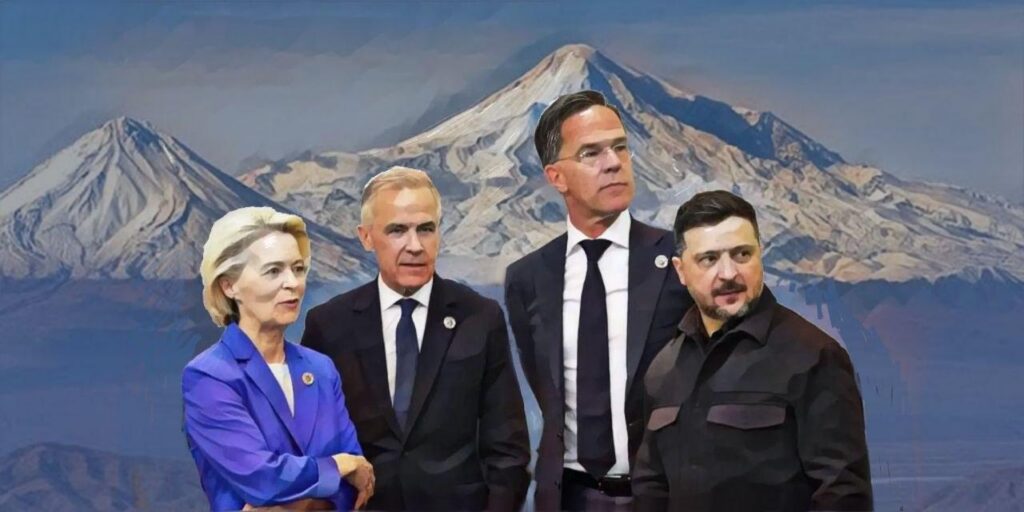
The 8th European Political Community summit in Yerevan highlighted deepening geopolitical fault lines while signaling that some post-Soviet countries, notably Azerbaijan and Armenia, are gradually shifting their geopolitical orientation away from Moscow. It is a realignment that Central Asian states are watching with increasing interest. On May 4, attention across post-Soviet space, from Russia and Belarus to Central Asia and the South Caucasus, turned toward Yerevan. Armenia, still a member of the Commonwealth of Independent States and the Eurasian Economic Union and formally tied to the Collective Security Treaty Organization despite freezing its participation, hosted Europe’s political leadership. Among those attending were French President Emmanuel Macron, NATO Secretary General Mark Rutte, European Commission President Ursula von der Leyen, European Council President António Costa, and prime ministers including Donald Tusk, Keir Starmer, and Petteri Orpo. Azerbaijani President Ilham Aliyev participated via video link. No Central Asian leaders attended the summit. Even so, the gathering carried a message for the region. Armenia hosted Europe’s political leadership while remaining tied to Moscow-led structures, including the CIS and the Eurasian Economic Union. For Central Asian governments pursuing their own multi-vector policies, the summit showed how a post-Soviet state can widen its diplomatic options without a clean break from Russia. The parallel is not exact, but it is visible. Kazakhstan and Kyrgyzstan remain in the Eurasian Economic Union, while Kazakhstan, Kyrgyzstan, and Tajikistan remain in the CSTO. All five Central Asian states maintain working ties with Moscow, while expanding contacts with the EU, Turkey, China, and the Gulf, part of a wider effort to diversify foreign policy options through closer engagement with Europe and other outside powers. Turkey was represented by Vice President Cevdet Yılmaz, the highest-level Turkish official to visit Armenia since then-President Abdullah Gül in 2008. Turkey and Azerbaijan largely positioned themselves as counterweights to the dominant European framing, marking one of the summit’s key geopolitical divides. Aliyev adopted a confrontational tone, announcing a suspension of relations with the Parliamentary Assembly of the Council of Europe and the European Parliament. “Instead of addressing fundamental problems of some member states, such as xenophobia, Islamophobia, antisemitism, migration, competitiveness, and homelessness, the European Parliament targets Azerbaijan, spreading slander and lies,” Aliyev said. “And the reason is that Azerbaijan restored its territorial integrity and sovereignty, put an end to separatism, and brought war criminals to justice.” In response, António Costa sought to soften tensions, emphasizing the summit’s historical significance as the first of its kind held in the South Caucasus and highlighting Aliyev’s participation as a symbol of peace efforts in the region. Cevdet Yilmaz focused on bilateral diplomacy, meeting Romanian President Nicușor Dan to discuss trade, regional issues, and global challenges. He also held talks with Armenian Prime Minister Nikol Pashinyan, the summit’s host. The two sides signed a memorandum of understanding on the joint restoration of the historic Ani Bridge, located on the border between the two countries and dating back to the 11th century. Yilmaz suggested that Armenia would benefit from closer alignment with Turkey and Azerbaijan, citing regional stability and economic integration. “This is one of the most strategically important regions in the world. Historically, it has always been a transit region. We believe that with the establishment of peace and normalization of the situation in the South Caucasus, all residents of the region will benefit first and foremost. Azerbaijan, Armenia, and Turkey—all these countries will benefit,” he said. European leaders used the summit to highlight other geopolitical tensions. Russian President Vladimir Putin and Belarusian President Alexander Lukashenko were again framed as adversaries. Ukrainian President Volodymyr Zelenskyy, invited to the summit, warned that the coming months would be decisive. “This summer will be the moment when Putin decides what to do next. We must push him toward diplomacy and not agree to sanctions relief,” Zelenskyy said. Belarusian opposition leader Sviatlana Tsikhanouskaya was also invited, underscoring Europe’s stance toward Minsk. Another focus of discussion was U.S. President Donald Trump, particularly his recent statements on tariffs on EU cars and plans to significantly reduce U.S. troop numbers in Germany. “This has been discussed for a long time, but the timing of this announcement was certainly unexpected,” EU foreign policy chief Kaja Kallas said, adding that it underscored the need to strengthen Europe’s role within NATO. Macron described the summit as part of a broader “European awakening” driven by developments in Ukraine and Moldova, and included Armenia in this process. “Let's be honest: eight years ago, no one would have come here. Eight years ago, this country was considered a de facto Russian satellite at the negotiating table,” he said. Despite criticism, Macron’s remarks pointed to a longer-term shift in Armenia’s geopolitical trajectory, one that has been developing over the past decade. Notably, the presence of Russian military bases in Armenia did not prevent the summit from taking place, nor did it hinder Zelenskyy’s participation. The Yerevan summit thus underscored a broader geopolitical realignment. For Central Asia, the signal was not that Armenia offers a model to copy, but that Europe is becoming more willing to engage with post-Soviet states seeking wider diplomatic space beyond Moscow.
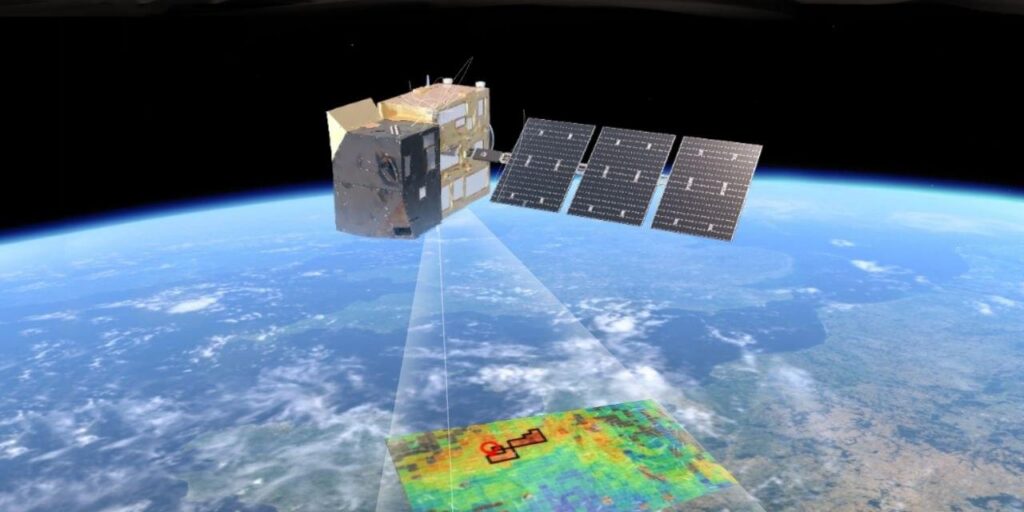
UNEP Interview: From Space, Central Asia’s Methane Challenge Comes Into Focus
Satellites are changing the way the world sees methane. What was once an invisible leak from a well, flare, pipeline, landfill, or coal mine can now be detected from space, traced to a specific site, and sent to governments and companies for action. A new analysis by the United Nations Environment Programme’s International Methane Emissions Observatory puts that system to the test. Its Methane Alert and Response System, known as MARS, uses 35 satellite instruments to identify major human-caused methane “super-emitters” and notify those responsible. UNEP says the system has already enabled 41 mitigation cases in 11 countries, covering sources estimated to have released 1.2 million tonnes of methane. For Central Asia, the findings are especially relevant. UNEP’s new data includes a rolling list of the world’s 50 largest satellite-detected methane sources, covering oil and gas, coal, and waste, and shows where rapid action may be possible. Several of those sources are linked to Turkmenistan’s oil and gas sector, placing the region firmly inside a global debate over methane transparency, climate responsibility, and whether satellite alerts can lead to action on the ground. Of the 50 sources featured in the latest UNEP/IMEO snapshot, China has the largest number, while Turkmenistan stands out sharply for Central Asia, with the second-largest individual source and four of the top ten. Methane is shorter-lived than carbon dioxide, but far more powerful in the near term. That makes cutting large leaks one of the fastest ways to slow global warming. The harder question, as UNEP’s latest data makes clear, is no longer only where the leaks are, but who responds when they are found. On April 30, UNEP/IMEO presented the new MARS findings, highlighting the growing role of satellite-based monitoring in identifying major methane sources and pressing governments and companies to act. The Times of Central Asia spoke with Meghan Demeter, MARS Programme Manager, International Methane Emissions Observatory, UNEP. TCA: What does the new MARS data reveal about Central Asia specifically that may surprise readers? Demeter: The latest MARS data products depict the region as one with growing engagement and significant mitigation potential. Responses to MARS notifications are increasing, supported in particular by designated national focal points who play a key role in coordinating follow-up with operators. Based on the published 2025 data alone, the response rate across Central Asia currently stands at 22%. Managing a high volume of alerts requires more effort to achieve very high response rates compared to countries that receive only a handful of notifications. Encouragingly, the region has already recorded nearly 20 mitigation cases, underscoring the strong potential for emissions reductions when large methane sources are identified and addressed. TCA: Why does Central Asia matter in the global methane debate, even if it is not the world’s largest methane-emitting region? Demeter: Across Central Asia, looking at the 2025 data alone, UNEP’s International Methane Emissions Observatory, through the Methane Alert and Response System (MARS), detected and notified 298 emission sources from the oil and gas sector. While satellites detect only a fraction of global methane emissions, satellites are highly effective at identifying so-called “super-emitters,” methane emission events so large they can be detected from space. These represent opportunities where action can deliver the greatest and fastest climate wins, while also catalyzing broader change. Regarding the “top 50” list of emission events, 11 of these sources are located in Central Asia, all from the oil and gas sector—the sector that also has the most potential for rapid, low-cost mitigation. This means that the region has high mitigation potential. It is important to note that this is dynamic. We expect the “top 50” list to evolve over the coming months, as satellite detection capabilities vary with observation conditions, including seasonal weather patterns such as cloud cover. Satellite detection is only one part of the solution. To address the broader methane challenge, we have to work system-wide. That means improving measurement and reporting to tackle smaller, more diffuse emissions in the oil and gas sector, which is what UNEP’s Oil and Gas Methane Partnership 2.0 (OGMP 2.0) is designed to do. TCA: Beyond the broad oil and gas picture, what types of sites are most visible in the satellite data? Demeter: In terms of sectors, oil and gas sector sources dominate in most countries, but we also see significant emissions from waste, for example, at a landfill near Tashkent in Uzbekistan, which is most visible during the summer months. In terms of emission sources within the oil and gas sector, most emissions come from malfunctioning flares, gas disposal facilities, and, frequently, significant emissions from midstream facilities (pipelines), all with very high mitigation potential. Although aging infrastructure in the region remains a significant challenge, with some methane leaks requiring major infrastructure fixes or replacements, documented cases already signal tremendous potential for quick, high-impact action in this region. TCA: Can you give a simple example of how a satellite detection becomes a confirmed mitigation case? Demeter: MARS is designed to turn satellite observations into real-world action. First, IMEO analyses satellite data to detect large methane plumes and attribute them to specific facilities and operators. Once attributed, UNEP notifies the relevant government authorities and, where applicable, the operating company. (We directly notify companies that are members of OGMP 2.0.) Along with the notification, we ask stakeholders to provide feedback about the detected emission event, including the emission source, an explanation for the cause of emissions, and any mitigation actions taken or status updates on the emissions. That information requires operators to investigate the emissions on the ground. Finally, IMEO continuously monitors the site to track progress and confirm when emissions are no longer observable by satellites. A recent case in Kazakhstan illustrates how this works in practice. After a satellite detection, the operator located a methane leak using simple Audio‑Visual‑Olfactory (AVO) checks and soap‑foam testing. The team quickly identified a faulty valve, replaced it, and fully stopped the emissions. This case shows that, while some methane reductions require complex, long‑term solutions, others can be achieved rapidly with basic techniques and straightforward repairs, delivering immediate climate benefits. TCA: What would measurable progress in Central Asia look like over the next year or two: fewer large plumes, faster responses, stronger reporting, or something else? Demeter: Measurable progress would be reflected across several dimensions. First, we would hope to see an increase in MARS response rates across all countries, which would signal stronger engagement and more effective follow-through. Responding to a MARS alert requires governments and operators to acknowledge alerts, investigate the source of emissions, and provide timely, substantive feedback on root causes and mitigation actions. As countries increasingly investigate major emission sources and take action to address them, we would expect to detect fewer large methane plumes over time, reflecting effective mitigation of the biggest sources. Lastly, but equally important, is progress on improved measurement and reporting to tackle smaller, more diffuse emissions in the oil and gas sector, which is what UNEP’s OGMP 2.0 is designed to do. That means seeing current Central Asian OGMP 2.0 members advance through OGMP 2.0’s reporting framework, as well as OGMP 2.0 membership growing in the region.
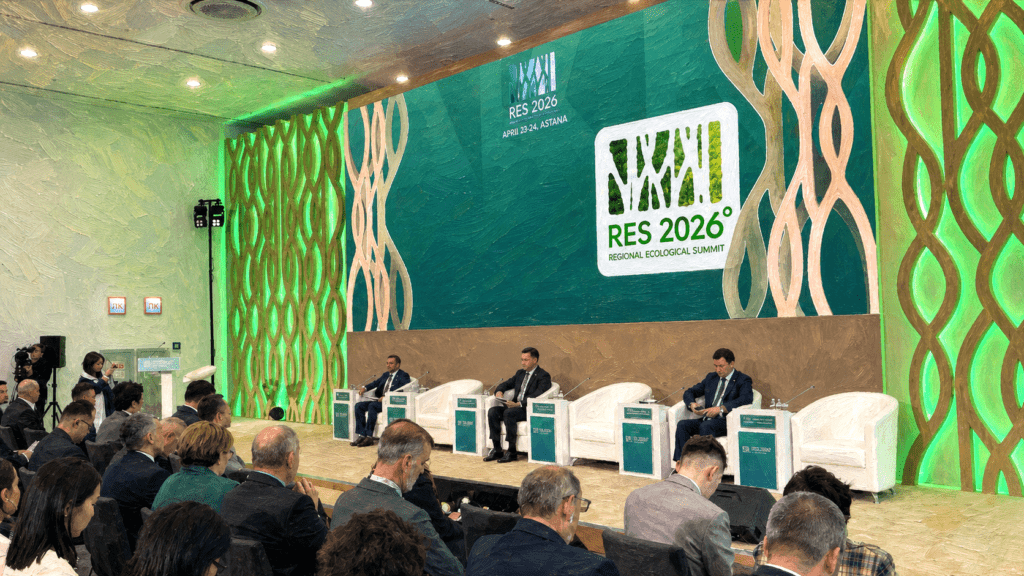
Opinion: The Regional Ecological Summit and the Making of a Central Asian Voice
On 22–24 April, Astana hosted the Regional Ecological Summit—a gathering of governments, international organizations, financial institutions, and civil society that marked a new level of ambition in Central Asia’s environmental diplomacy. Fifty-eight sessions were held across three days at a moment when Central Asia’s ecological agenda is becoming inseparable from its political and economic future. The opening ceremony was attended by the presidents of all five Central Asian states. The summit adopted the Astana Declaration on Ecological Solidarity in Central Asia and brought renewed attention to the need to reform the International Fund for Saving the Aral Sea (IFAS). Taken together, these developments signal more than procedural diplomacy. They point to growing political momentum. The region has never lacked shared history or channels of communication. Russian remains a practical language of intergovernmental exchange, and borders, economies, rivers, energy systems, and labor markets have tied these countries together long before contemporary climate diplomacy gave this interdependence a new vocabulary. For decades, much external analysis of Central Asia expected this interdependence to produce confrontation, particularly around water and energy. Those risks remain real. Yet the Astana summit showed a more complex trajectory. Climate change, biodiversity loss, water insecurity, land degradation, and food security are not separate national problems neatly contained within borders. Addressing them is becoming one of the fields through which regional coherence is being built. The significance of the Summit lies less in ceremonial language than in the consolidation of multiple ecological agendas into a visible diplomatic architecture. Through its panels and high-level discussions, the Summit placed Central Asia’s natural heritage not at the margins of development but at its center. Ecosystems, rivers, glaciers, mountains, and landscapes are not only environmental assets. They are conditions for prosperity, stability, and resilience. Kazakhstan’s chairmanship of IFAS reopened the question of whether the Fund, long criticized for its limitations, can be reworked rather than left as a symbol of failed regional environmental governance. Kazakhstan’s proposal for an International Water Organization should be read in the same frame: it is not merely a technical proposal about water governance but an attempt to move a Central Asian concern into the language of global institutional reform. Kyrgyzstan’s mountain agenda and Tajikistan’s glacier diplomacy also belong to this broader pattern. They are not just isolated national branding exercises. Together with Uzbekistan’s increasingly active regional posture, they form a wider mosaic: each country brings a distinct ecological priority, but these priorities are becoming legible as parts of one regional perspective, and its voice carries more weight when presented as such. This is particularly important in the current geopolitical moment. As larger powers turn inward, compete over corridors, or speak about Central Asia through the old grammar of influence, the region is attempting to define itself not as terrain for another “Great Game" but as a pole of its own. This does not mean distance from external partners. On the contrary, the United Nations was a strategic partner of the Summit, and many formats involved major international organizations, European partners, development institutions, and civil society. The difference is in the direction of agency: external engagement is increasingly being organized around regional priorities, not merely around external agendas. The limitations, however, are equally clear. The summit exposed the financial asymmetry at the heart of climate politics. Central Asia contributes only a small share of global greenhouse gas emissions, yet it is disproportionately affected by its impacts, warming around twice as fast as the global average. Shrinking glaciers, droughts, floods, and deteriorating water systems are already visible across the region. Without more accessible and better-targeted climate finance, regional declarations will struggle to translate from diplomatic coherence into concrete implementation. This is where a common regional voice becomes more than symbolism. Individually, Central Asian states can present national adaptation needs. Collectively, they can argue that the region’s climate vulnerability is systemic, transboundary, and underfinanced. That argument is more difficult to ignore. Astana did not resolve the contradictions of Central Asian ecological politics. It could not. IFAS reform remains difficult. Climate finance remains insufficient. Water management is politically sensitive. But the Summit made visible something that has been developing for some time: Central Asia is no longer only reacting to ecological risks. In a fragmented international environment, Central Asia is trying to convert risk into a basis for regional diplomatic weight, and this may become one of the region’s most important political resources. The views expressed in this article are those of the author and do not necessarily reflect the official policy or position of the publication, its affiliates, or any other organizations mentioned.
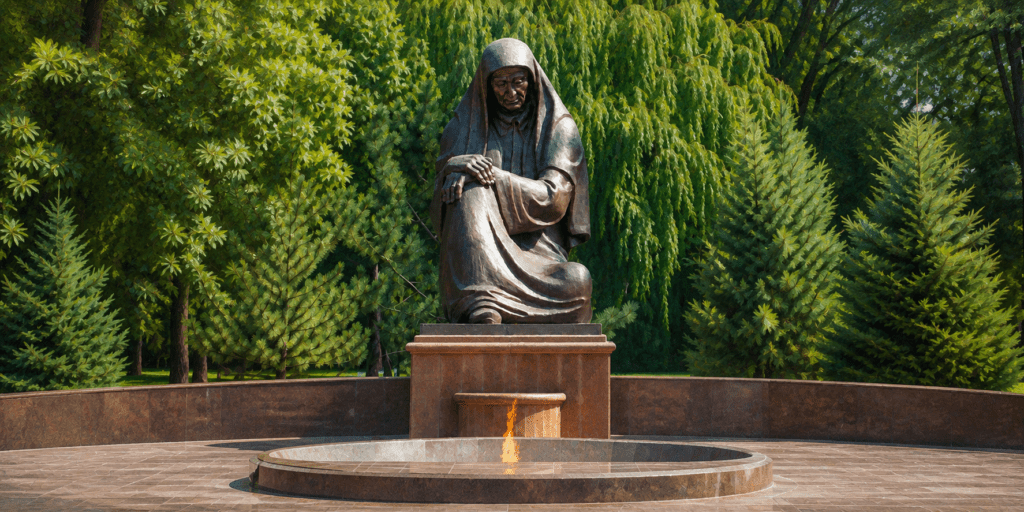
Victory, Memory, and Moscow: Central Asia’s Changing May Calendar
May is when Central Asia’s past crowds into the public square. Workers, soldiers, veterans, constitutions, unity campaigns, and the legacy of World War II all compete for space on the calendar. The dates are familiar across the region, but their meanings are no longer the same. Kazakhstan marks People’s Unity Day on May 1, Defenders’ Day on May 7, and Victory Day on May 9. Kyrgyzstan has a May calendar built around Labor Day, Constitution Day, and Victory Day. Uzbekistan has recast May 9 as the Day of Remembrance and Honor. Turkmenistan lists May 9 as Victory Day of the 1941-1945 Great Patriotic War, but it no longer carries the same public weight as the country’s main state holidays. Those choices show how each state is handling its Soviet past. May 1 can mean labor, unity, or almost nothing. May 9 can mean victory, mourning, family memory, or careful diplomacy. In Central Asia, the politics of memory rarely move through open rejection. It works through renaming, recalibrating, and changing the optics. Russia still treats May 9 as a central ritual of state power. Victory Day marks the Soviet defeat of Nazi Germany in what Russia calls the Great Patriotic War. Under Vladimir Putin, it has become a display of military strength, national sacrifice, and confrontation with the West. Since Russia’s full-scale invasion of Ukraine in 2022, that message has become more direct. This year, the image projected from Moscow will be weaker. Russia is preparing to hold its May 9 parade on Red Square without the usual display of military hardware. Tanks and missile systems, long central to the spectacle, are being kept away. Russia’s Defense Ministry cited the “current operational situation,” while the Kremlin linked the change to Ukrainian attacks. For Central Asian governments, that image will be hard to separate from their own handling of Victory Day. Moscow has long used May 9 to gather friendly leaders and place the post-Soviet region inside a shared wartime story. Attendance in Moscow has become a diplomatic signal. Absence has become one too. In recent years, Victory Day diplomacy has shown how Central Asian governments try to respect wartime memory while avoiding full alignment with Russia’s narrative. This year, at least some Central Asian leaders are again expected in Moscow. Kazakhstan’s Kassym-Jomart Tokayev and Kyrgyzstan’s Sadyr Japarov have been reported among those planning to attend, though the Kremlin has not yet published a full list of foreign guests. Central Asian states cannot simply discard May 9. Millions of people from the region served in the Red Army or worked behind the front during World War II; from Kazakhstan alone, around one million people contributed to the war effort, with nearly 271,000 soldiers still listed as missing. Families still carry those memories. Monuments, veterans’ payments, school events, and wreath-laying ceremonies remain important. For many people, Victory Day is personal before it is geopolitical. Yet governments have changed the tone. Kazakhstan still marks Victory Day as a public holiday, but large military parades are not at the center of the commemoration. The state tends to favor ceremonies, concerts, veterans’ support, and local memorial events. This leaves space for remembrance without copying Moscow’s militarized script. In Central Asia, Victory Day has often come without much pomp, but with plenty of feeling. Kazakhstan's May sequence makes that layering unusually clear. May 1 is People's Unity Day, tied to the country's multiethnic identity and the state's long-running focus on interethnic harmony. May 7 marks Defenders' Day, linked to the creation of Kazakhstan's own armed forces after independence. May 9 follows two days later. The order places Soviet victory memory alongside two post-Soviet themes: unity at home and national defense under Kazakhstan's flag. Kyrgyzstan keeps May more Soviet-shaped. May 1 remains Labor Day; May 5 is Constitution Day; May 9 is Victory Day. Together, they give the month a strong public rhythm, with work calendars often adjusted around weekends and transferred days off. Uzbekistan has taken a different path. May 9 is not officially called Victory Day. It is the Day of Remembrance and Honor. The change is subtle, but important. It keeps wartime memory, but moves the focus from military triumph toward mourning and national dignity. In 2026, President Shavkat Mirziyoyev reviewed preparations for the holiday, including military training, support for service members, and events connected to memory and honor. The language lets Uzbekistan remember the dead without placing Moscow at the center of the story. Tajikistan also retains Labor Day and Victory Day. That continuity reflects close security, migration, and economic ties with Russia. It also reflects Tajikistan’s own wartime losses. But Tajikistan’s calendar also has a separate post-Soviet track. National Unity Day, marked in June, commemorates the end of the country’s civil war. That gives the state two different kinds of remembrance, one Soviet and regional, the other domestic. Unsurprisingly, Turkmenistan offers a more controlled version. Victory Day remains on the official list of holidays and memorable dates, but it sits inside a calendar dominated by neutrality, independence, the Turkmen horse, carpets, and the poetry of Magtymguly. The Soviet frame survives, but is absorbed into a wider national story. Across the region, the pattern is not erasure; it is selective preservation. Central Asian states still honor veterans, maintain monuments, and teach World War II as a defining event, but they also rename and soften Soviet holidays. They move the emphasis from Moscow to national capitals, from military victory to remembrance, from class struggle to unity, and from Soviet identity to state sovereignty. That makes May one of the most revealing months in the regional calendar. The same week can celebrate workers, the constitution, armed forces, unity, sacrifice, and victory. Each country chooses a different mix, and none of those choices is accidental. They say something about relations with Russia, views of Soviet history, and each state’s need to build legitimacy at home. This year, Russia’s scaled-down parade sharpens the contrast. For years, Victory Day projected strength; in 2026, the absence of tanks and missile systems will project caution. Moscow still presents the Soviet victory as a central part of Russian state identity, but Central Asian governments increasingly frame May 9 through their own national calendars. The dates are old. Their meanings keep changing.
Sunkar Podcast
Uzbekistan’s Sindarov Makes Breakthrough in World Chess